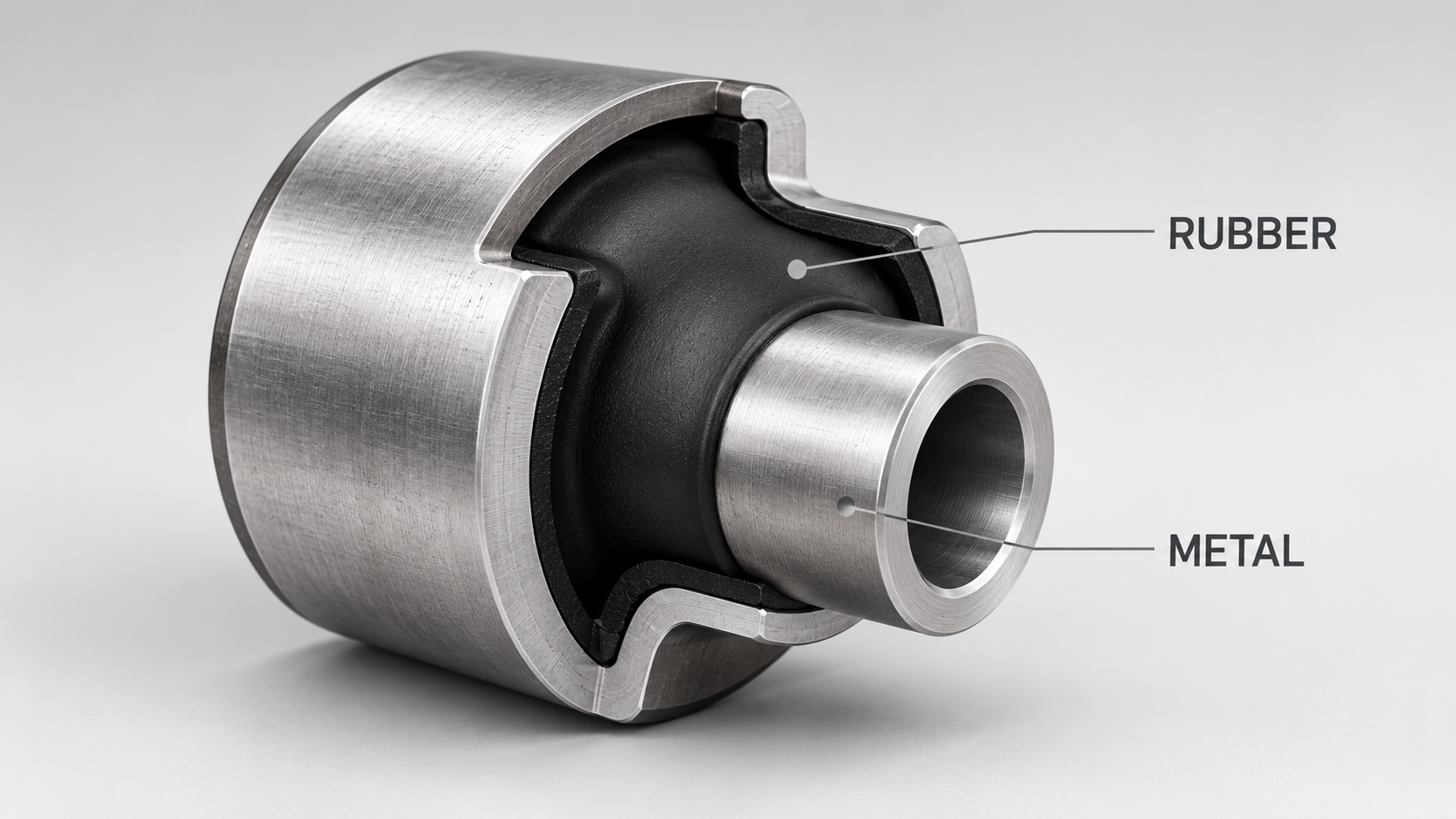
Rubber-to-metal bonded components are used where a product must carry load, control movement, reduce vibration or withstand demanding service conditions. Typical applications include engine mountings, suspension bushes, anti-vibration mounts and custom industrial components.
For a suspension application of this process, explore our silent block bushes.
What Is the Rubber-to-Metal Bonding Process?
The rubber-to-metal bonding process is a controlled manufacturing method that chemically and mechanically joins an elastomer to a prepared metal insert. A dependable bond is not produced by adhesive alone; it depends on correct material selection, metal preparation, controlled moulding and verified curing conditions.
For a detailed view of Maurflex manufacturing capability, see our rubber-to-metal bonding process page.
1. Component Design and Material Selection
The process begins with the application. The part geometry, working load, movement, operating temperature and exposure to oil, water or chemicals guide the selection of the rubber compound and the metal insert. Natural rubber, NBR, EPDM and other compounds can be selected according to the application requirements.
2. Metal Surface Preparation
Metal inserts must be free from oil, rust, scale and loose particles before bonding. Cleaning and controlled surface roughening improve adhesion by providing a stable, prepared surface for the bonding system. The method is selected according to the component, material and specification.
3. Bonding-Agent Application
A compatible primer and bonding agent are applied to the prepared metal surface. Uniform coverage and correct drying conditions are important because an uneven coating can affect bond integrity. The coated insert is handled carefully before moulding to prevent contamination.
4. Moulding and Vulcanisation
The prepared insert is placed in the mould with the specified rubber compound. Controlled heat, pressure and curing time vulcanise the rubber and form the rubber-to-metal bond. Process settings are managed to achieve accurate dimensions, consistent hardness and reliable adhesion.
5. Inspection and Bond-Strength Verification
Quality checks can include visual inspection, dimensional measurement, hardness checks and bond-performance evaluation. The testing plan depends on the part specification and application. These checks help confirm that the component is ready for its intended automotive or industrial use.
Why Process Control Matters
A properly controlled bonding process improves durability, vibration isolation and component reliability. It also helps reduce the risk of separation under load, temperature changes and repeated movement. For custom parts, supplying a drawing, sample, performance requirement and expected quantity helps the manufacturer review the application accurately.
Discuss Your Requirement
Maurflex manufactures rubber-to-metal bonded components for OEM, aftermarket and industrial applications. For a quotation, share your drawing or sample, material preference, dimensions, operating conditions and required quantity through our contact page.